Luxury Assets
The Yacht Is the Residence
Superyachts are no longer assets. They're fiscal infrastructure

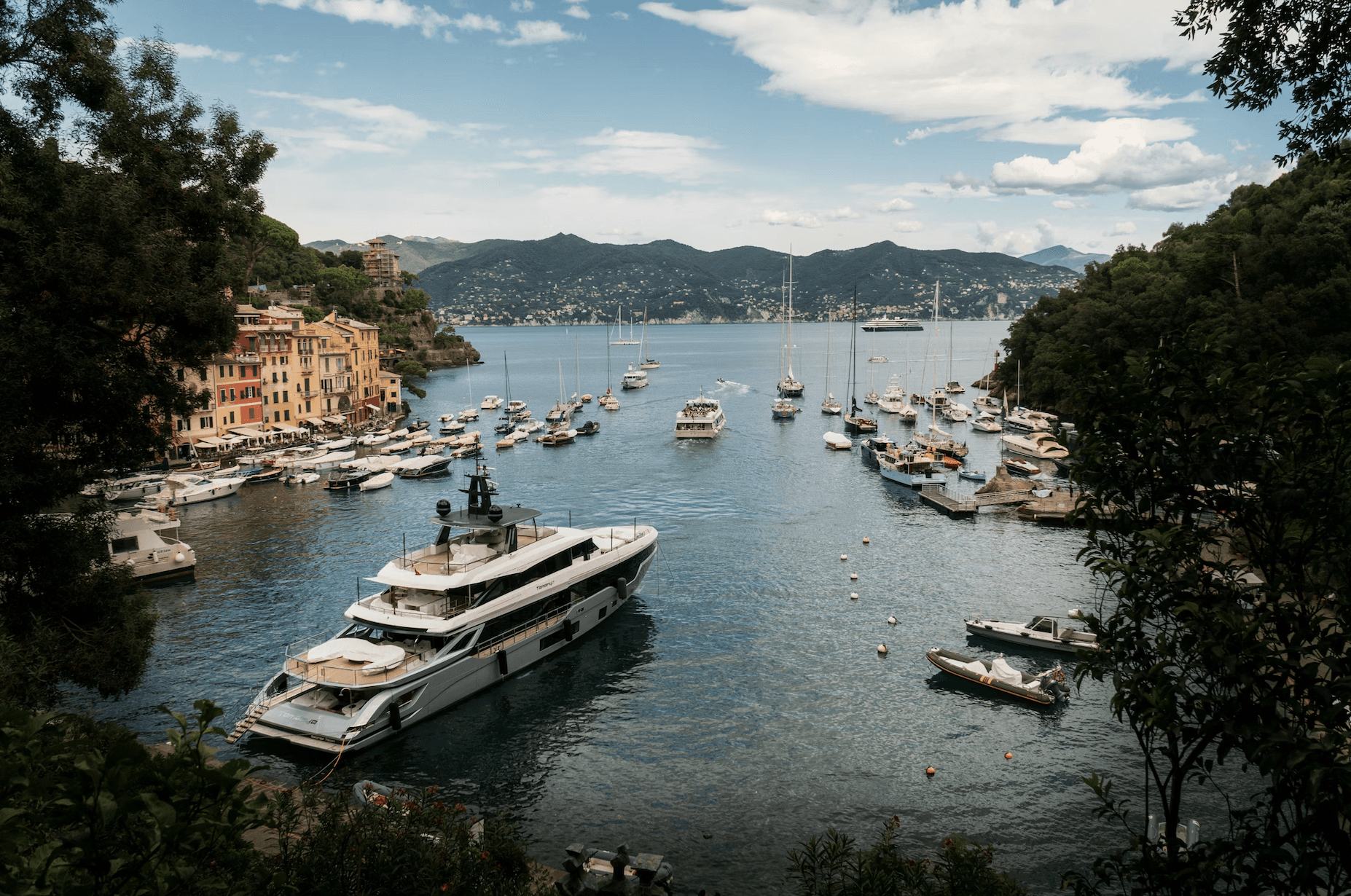
Something has inverted at the top of the yacht market. The vessel is no longer a vacation possession. For a growing share of UHNWI owners, it has become the primary residence, and the villa or apartment ashore has become the secondary base. The shift shows up in design briefs at Feadship, Lurssen, and Oceanco, in the rising share of full-displacement explorer yachts in the new-build order book, and in the working economics of running a 90-metre vessel as a year-round home rather than a seasonal asset.
The Global Order Book 2025, compiled by BOAT International from data on 185 shipyards across five continents, recorded 1,138 superyacht projects of 24 metres or longer under construction or on order as of September 2024 (BOAT International, 2024). Azimut-Benetti led the order book for the 25th consecutive year with 164 units totalling 5,905 metres, roughly 20 percent of the 24-metre-plus market. Lurssen, the German specialist in vessels above 80 metres, held 12 projects averaging 104.5 metres each. That data point matters: persistent depth at the very top of the size range, where the residential thesis is most plausible. The market has cooled from its 2022 post-pandemic peak, but the cooling is described by industry brokers as a return to stable, normalised growth around 5 percent annually (Burgess, 2024).
What the order book data does not capture is the change in how owners use the asset. Emma Spence, in her ethnographic study of superyacht owners in Monaco, documented how the vessel functions for the very wealthy as more than a recreational possession. The yacht, Spence argues, is a site for performance of wealth, management of social hierarchy, and conduct of business that requires extreme privacy (Spence, 2016). The yacht is, in her framing, an extension of the principal’s social and operational identity, not a holiday accessory.
What accelerated since 2020 is the time spent on board. The pandemic forced extended on-board residence for many owners. The experience changed perceptions. Many discovered the yacht functioned as a secure, mobile, fully serviced residence in ways the ashore villa could not match. Many owners who made this discovery did not return to the previous pattern. Year-round on-board residence, with the yacht moving between Mediterranean (May to September), Caribbean (December to April), and intermediate stops, has become the template for a meaningful subset of largest-vessel owners.
The fiscal architecture is worth examining. A vessel registered under a commercial yacht flag (Cayman, Marshall Islands, Malta) and operated through a chartering structure can offset significant working cost against charter revenue while permitting personal use within defined limits. The owner’s tax residence is decoupled from the vessel’s flag. For UHNWI families restructuring fiscal residence away from London after the April 2025 non-dom reforms, or from Spain after the closure of the Golden Visa programme, the yacht-as-residence model offers continuity through the transition. The vessel does not need to wait for new fiscal residence to crystallise. It operates regardless.
Charter revenue economics support the residence thesis from a financial angle. The global yacht charter market was valued at approximately 13.33 billion dollars in 2024 by Market Research Future, projected to reach 28.64 billion by 2035 at 7.2 percent CAGR. Research and Markets places 2025 value at 18.29 billion with 11.5 percent CAGR through 2029. The divergence reflects methodology rather than disagreement on direction. The charter market is growing at roughly twice the rate of global luxury services more broadly. A 90-metre vessel chartered for 8 to 12 weeks per year at 800,000 to 1.4 million euros per week generates revenue offsetting between 30 and 60 percent of annual operating cost, depending on flag, route, and crew structure.
Brokerage architecture has matured to support full-residency operation. Edmiston reported 1.25 billion euros in superyacht sales for 2024, holding its position as leading brokerage by transaction value. Camper and Nicholsons, founded in 1782, operates the deepest charter-and-management infrastructure with offices spanning Monaco, London, New York, Miami, and Hong Kong. Burgess sponsors the Monaco Yacht Show and Cannes Yachting Festival, anchoring the social calendar synchronising with the yachting season. Brokerages serving the residential-vessel owner are no longer transactional intermediaries. They are full-service coordinators handling crew payroll, refit project management, charter marketing, regulatory compliance, and insurance.
Chris Paris, in his analysis of super-rich residential geography, identified the shift toward multi-residence portfolios held by hyper-mobile principals (Paris, 2013; Paris, 2016). The yacht extends his thesis to a logical conclusion. Where the multi-residence portfolio still required the principal to transit physically between fixed assets, the yacht eliminates the transit. The residence moves with the principal. For owners whose business demands continuous geographic flexibility, particularly those operating across two or more continents, the yacht resolves a coordination problem fixed real estate cannot.
Infrastructure built up around residential yachting is real. Monaco’s Port Hercule, the marina at the heart of Monaco’s UHNWI calendar, hosts the Monaco Yacht Show in September with approximately 125 yachts on display, the largest annual gathering of superyacht owners and brokers globally. Porto Cervo in Sardinia, Antibes’ Port Vauban, and Saint-Tropez during the Voiles de Saint-Tropez (early October) constitute the European core. The Caribbean season anchors around Antigua’s Falmouth Harbour, Saint Maarten’s Simpson Bay, and the Bahamas. Florida’s Yacht Haven at the Lauderdale Yacht Club and Fisher Island provide the Atlantic coast operational base. These are not vacation marinas. They are working hubs with crew rotation, refit yard partnerships, and dedicated brokerage offices.
A counterpoint worth holding. Yacht-as-residence remains, even at the current uptake rate, a minority phenomenon. The majority of yacht owners still treat the vessel as seasonal or recreational, with annual on-board occupancy of 4 to 8 weeks. The 6,055 yachts above 30 metres globally as of April 2024 (Burgess presentation at Superyacht Investor London 2024) include perhaps 400 to 600 vessels operated in a genuinely residential mode. The thesis applies primarily to vessels above 60 metres with full-time crew above 20 and operating budgets exceeding 8 million euros annually. For smaller vessels and shorter on-board occupancy, the seasonal model remains dominant.
But the underlying trend favours the residential thesis. Knight Frank’s Wealth Report 2026 identifies the Ultra-Mobile owner archetype, a principal spending fewer than 90 days per year in any single residence (Knight Frank, 2026). For this archetype, a fixed residence in any single location is less efficient than a mobile, fully serviced platform. The yacht is the working answer to the Ultra-Mobile question, and the share of new-build orders specified for full residential operation has grown materially since 2020. Brokerages still pricing yachts as pure consumption assets are missing the transformation. Those who price them as hybrid mobile real estate are advising clients more accurately and capturing premium fees.
References
BOAT International (2024) The Global Order Book 2025. London: BOAT International Media Limited, December 2024.
BOAT International (2025) The Global Order Book 2026. London: BOAT International Media Limited, December 2025.
Burgess (2024) Superyacht Market Update presented at Superyacht Investor London 2024. London: Burgess Yachts Limited.
Camper and Nicholsons (2025) Annual Market Review 2024/2025. Monaco: Camper and Nicholsons International.
Edmiston (2025) Edmiston Leads Superyacht Market in 2024 with 1.25 billion euros in Sales. Monaco: Edmiston and Company, January 2025.
Hay, I. and Beaverstock, J.V. (eds.) (2016) Handbook on Wealth and the Super-Rich. Cheltenham: Edward Elgar Publishing. ISBN 978-1-78347-403-5.
Knight Frank (2026) The Wealth Report 2026. London: Knight Frank Research.
Knowles, C. (2022) Serious Money: Walking Plutocratic London. London: Allen Lane (Penguin).
Market Research Future (2025) Yacht Charter Market Research Report: Forecast to 2035. Pune: Market Research Future.
Paris, C. (2013) ’The homes of the super-rich: Multiple residences, hyper-mobility and decoupling of prime residential housing in global cities’, in I. Hay (ed.) Geographies of the Super-Rich. Cheltenham: Edward Elgar Publishing, Chapter 6.
Paris, C. (2016) ’The Residential Spaces of the Super-Rich’, in I. Hay and J.V. Beaverstock (eds.) Handbook on Wealth and the Super-Rich. Cheltenham: Edward Elgar Publishing, Chapter 12, pp. 244-263.
Research and Markets (2025) Yacht Charter Market Report 2025. Dublin: Research and Markets.
Spence, E. (2016) ’Performing Wealth and Status: Observing Super-yachts and the Super-rich in Monaco’, in I. Hay and J.V. Beaverstock (eds.) Handbook on Wealth and the Super-Rich. Cheltenham: Edward Elgar Publishing, Chapter 14.
Superyacht Investor (2024) ’Talking Markets: Superyacht Investor London 2024.’ Conference proceedings, July 2024.